Showing posts with label guns. Show all posts

Thursday

How difficult would it be to repeal the Second Amendment?


Retired Supreme Court Justice John Paul Stevens called for the repeal of the Second Amendment on Tuesday, wading into the charged political debate over gun control that was reignited by several mass shootings in recent months.

It’s a familiar appeal from the 97-year old jurist, who was named to the bench by President Gerald Ford in 1975 and retired in 2010. But Stevens renewed his plea in an op-ed in the New York Times, three days after activists staged massive gun control demonstrations in Washington, D.C., and in other cities around the country and world over the weekend. Stevens praised the protesters for demanding reforms to current gun laws, but said they should go further.

“The demonstrators should seek more effective and more lasting reform. They should demand a repeal of the Second Amendment,” Stevens wrote.

Repealing the amendment, Stevens said, would effectively overturn the controversial 2008 Supreme Court ruling D.C. v. Heller, which found that the Second Amendment protected “an individual right to possess a firearm” for the purpose of self-defense.

In his op-ed, Stevens, who dissented in the 5-4 decision, wrote that the ruling gave the National Rifle Association “a propaganda weapon of immense power.”

He added: “Overturning that decision via a constitutional amendment to get rid of the Second Amendment would be simple and would do more to weaken the NRA’s ability to stymie legislative debate and block constructive gun control legislation than any other available option.”

So, what would the process of repealing the Second Amendment actually look like?

For starters, it would require the ratification of another amendment. This isn’t an easy step, but it’s been done before: After the U.S. prohibited alcohol sales in the 18th Amendment, the country later repealed the controversial amendment about a decade and a half later, with the 21st amendment.

There are two pathways for proposing another amendment. In the first scenario, Congress proposes an amendment with a two-thirds majority vote in the House and Senate.

The other option is for two-thirds of state legislatures — that’s 34 states — to call a constitutional convention. In both scenarios, three-fourths of the states — 38 states — would have to give their stamp of approval to ratify the proposed amendment.

So far, however, none of the 27 amendments to the Constitution have come out of the constitutional convention process. And remember in its 223-year lifespan, the Constitution has been amended only 27 times. The last amendment, concerning U.S. legislators’ salaries, was ratified in 1992.

What’s next?

The social media reaction to Stevens’ suggestion was swift.

Some scholars noted that Stevens’ op-ed could be counterproductive to legislative efforts to regulate guns, which would have broader public support than repealing the Second Amendment. While only about a fifth of Americans support repealing the Second Amendment, according to a February Economist/YouGov poll, about 60 percent of those polled said they favored stricter gun laws.

“To frame it as we can only have gun regulations if we repeal the #2Amendment” is not only wrong as a matter of constitutional text & history but also sets the movement up for failure,” the legal expert Elizabeth Wydra tweeted.
 
Josh Chafetz, a professor at Cornell Law School, said that Democrats could focus their energy instead on winning back the White House and Senate. Then, they could “appoint judges who share Stevens’s views and who will therefore narrow and eventually overturn Heller,” Chafetz wrote in a tweet. .

In a statement Tuesday, NRA Executive Director Chris Cox called Stevens’ proposal a “radical idea.”

Stevens’ arguments is evidence that “the gun-control lobby is no longer distancing themselves from the radical idea of repealing the Second Amendment and banning all firearms,” Cox said.

Tuesday

As Students Demand Gun Control, Arms Manufacturers Continue Targeting “Next Generation of Shooters”


JUAN GONZÁLEZ: In Parkland, Florida, students returned to Marjory Stoneman Douglas High School on Sunday afternoon. It was their first time inside their school since February 14, when a 19-year-old former student, Nikolas Cruz, walked into the school and opened fire with an AR-15 semiautomatic rifle, killing 17 people. The students’ return is part of what school officials are calling a phased reopening of the school.

This comes as lawmakers return to Capitol Hill today after a vacation. Congress is facing massive pressure to pass gun control measures amidst the rise of an unprecedented youth movement, led by Marjory Stoneman Douglas High School students who survived the mass shooting.

Meanwhile, President Trump has reiterated his calls to arm teachers with concealed weapons. This is Trump speaking at CPAC, the Conservative Political Action Conference, on Friday.

PRESIDENT DONALD TRUMP: The beauty is, it’s concealed. Nobody would ever see it, unless they needed it. It’s concealed! So this crazy man who walked in wouldn’t even know who it is that has it. That’s good. That’s not bad, that’s good. And a teacher would have shot the hell out of him before he knew what happened. They love their students. They love those students, folks. Remember that.

AMY GOODMAN: According to the Gun Violence Archive, at least 69 kids under the age of 18 have been shot, and 26 of them were killed, since the mass shooting at Marjory Stoneman Douglas High School less than two weeks ago.

Well, to speak more about firearms, gun manufacturers and the unprecedented youth movement for gun control, we’re joined now by The Intercept’s investigative reporter Lee Fang, his new piece headlined “Even as a Student Movement Rises, Gun Manufacturers Are Targeting Young People.”
Lee, welcome back to Democracy Now! How are gun manufacturers targeting young people?

LEE FANG: Hi, Amy. Thanks for having me.
You know, we took a look at investor reports from gun manufacturers and other gun industry companies, and there’s a number of reasons why, but gun executives say they’re making a new push to target younger generations, teenagers, millennials, mainly because gun sales have been plummeting over the last year. That’s partially because, with a Republican president and Republicans in power in Congress, there has been little fear of gun control. And what the gun industry has done historically is that they’ve used the potential for gun control to spur panic buying, often using third parties like the NRA to kind of whip up hysteria. And without that kind of fear of gun control, there’s been less gun sales, so they’re attempting to grow their market.

Also, there’s new analysis from the gun industry showing that young people are not buying guns like older generations for hunting. They’re mostly kind of emulating video game culture. You know, they’re going to gun stores, buying targets of vampires and zombies, and going to the gun range and buying really sophisticated weapons, lots of ammunition. This is really, as one gun industry executive said, the Xbox generation that they’re trying to target. So, even as there’s a new youth-led student movement calling for gun control, this is coming at a time when the gun industry is hoping to grow their market share by selling more guns to young people.

JUAN GONZÁLEZ: And, Lee, could you also talk about the Koch brothers and guns and the network that the Koch brothers have built up to fund campaigns, both advocacy campaigns and political campaigns?

LEE FANG: Well, you know, the interesting thing here with the Koch brothers and guns is that I don’t believe that the Koch brothers have a strong interest in gun control or no gun control. But they do understand that this is an issue that whips up the conservative base, that Republican voters are very likely to vote on gun issues. So, you know, historically, we’ve seen the Koch brothers use their undisclosed money organizations to fund the NRA. That’s because the NRA will go out and engage in election efforts to activate Republican base voters to get them to the polls. So, you know, when you see television advertisements from the NRA, that money does come from NRA members, from gun companies, but it also can come from groups like the Koch brothers, that are hoping to use them as kind of an identity group to activate their base voters.

AMY GOODMAN: Can you talk a little about American Outdoor Brands? It used to be known as Smith & Wesson, right?

LEE FANG: That’s right. This is a company that sells a number of different rifles, formally known as Smith & Wesson. They manufactured the AR-15 that was used in the Parkland massacre. And this is a company that has donated millions of dollars to the NRA. They’ve engaged in kind of marketing practices with the NRA, saying that, you know, if you buy a certain number of weapons, if you buy guns from us, a portion of the sales will go to the NRA. They’ve gone out and provided big checks to the NRA, as well, kind of celebrating their partnership. And it’s a major company that sells weapons in retail stores all around the country.

AMY GOODMAN: And tell us about James Debney, the CEO of American Outdoor, talking further.

LEE FANG: Right. James Debney has been the longtime chief executive. And as he kind of explained in investor presentations throughout the year last year, he talked about the need to grow their market share among young people, that the company is doing more marketing towards younger generations and targeting millennials. Again, if you look at just the stock price of the major gun companies, of American Outdoor Brands, but also Sturm Ruger, Vista Outdoor—these are the largest gun and ammunition companies—they’ve really tanked over the last. So these companies are hurting. They’re hoping to bring in new consumers, and they’re noticing that young people are very particular types of consumers. They’re buying guns to try to emulate first-person shooters. And the gun companies are very conscious of this and trying to market their weapons to them.

JUAN GONZÁLEZ: And what do you make of the decision by some of the major corporations in America now to sort of cut their ties with the NRA, get rid of credit cards, NRA credit cards, by some of the financial Institutions? What’s your sense of what that represents?

LEE FANG: You know, I think it’s an interesting development. But the NRA is organized through multiple 501(c) tax entities. We don’t really understand their financials, because they don’t disclose their donors. How much of a hit this constitutes, we don’t know. It’s certainly not a positive development for the NRA to see so many major corporations, from airlines to car rental companies, cutting their financial ties with the group. But at the same time, you know, the NRA is a big-money organization. They can fundraise, not just from their members, but from gun companies and other Republican donors. I think it’s too early to be seen what this financial impact is. I think the NRA is going to spend a lot of money this year, especially if states or Congress picks up gun control. They will use those political developments to kind of activate their base and likely receive even more donations.

AMY GOODMAN: Lee, as you write about the efforts by gun manufacturers to market to young people, through magazines like Junior Shooters, we’re showing some of the magazine—the covers of the magazine, for our viewers, which show young people holding rifles and handguns, with cover lines like “Glocks Are for Girls” and “Meet Spud: Fast Draw at Age 11.” Other companies, including gun manufacturer Hogue, Inc., sell things like green glow-in-the-dark handguns and shotguns and accessories, marketed to kids so they can, quote, “hunt zombies in style,” what you referred to earlier. Explain the whole push to go to younger and younger people.

LEE FANG: Right. And this is not something that’s particularly new. The gun companies have been doing this for a while. We’re just seeing kind of an increased effort. But, you know, just like any other major consumer industry, the gun company knows that they will have more loyal and more active consumers if they target people who are very young, to kind of lock them in as buyers who will repeatedly go out and buy weapons and accessories and ammunition.

So we see these marketing efforts targeted explicitly to children, you know, with guns that kind of look like they’re from a video game, or they’re pink and very friendly-looking weapons. There’s been partnerships even with video game companies. Electronic Arts, several years ago, had a partnership with several gun companies, where, you know, for a first-person shooter, players could play the game and then go be directly connected to a marketplace where they could buy weapons from the game directly from the manufacturers. So there’s a multitude of marketing efforts that are geared towards young people. And, you know, I think if Congress is looking towards enacting gun control, the marketing efforts might be a part of that larger national conversation.

Friday

How US gun culture compares with the world in five charts


(CNN)The United States. Home to liberty, the pursuit of happiness and the most mass shootings in the world.
America's unique relationship to gun ownership -- enshrined as a right in its constitution -- is also in the middle of an emotional and divisive debate about the meaning of the Second Amendment of the United States Constitution. Twenty-seven words that give its citizens the right to own guns and also, in the views of many critics, helped usher in a culture that sees more of its own people killed by fellow citizens armed with guns than in any other high-income nation in the world.
Gun-related deaths unfold in tragic circumstances across the country daily, with more than 1,800 people killed by guns this year alone, according to Gun Violence Archive, a not-for-profit group. But it is often mass shootings that reignite the debate over gun control in the US and that shine the spotlight on its position as a global outlier.

The number of firearms available to American civilians is estimated at around 310 million, according to a 2009 National Institute of Justice (NIJ) report.
India is home to the second-largest civilian firearm stockpile, estimated at 46 million.
The most updated estimates -- now more than a decade old -- place the worldwide civilian gun cache at around 650 million. According to Switzerland-based Small Arms Survey, the number of civilian guns has most likely risen since 2007. Firearm production continues to proliferate worldwide, outweighing the effects that gun destruction might have.
According to the Small Arms Survey, the exact number of civilian-owned firearms is impossible to pinpoint because of a variety of factors including arms that go unregistered, the illegal trade and global conflict.
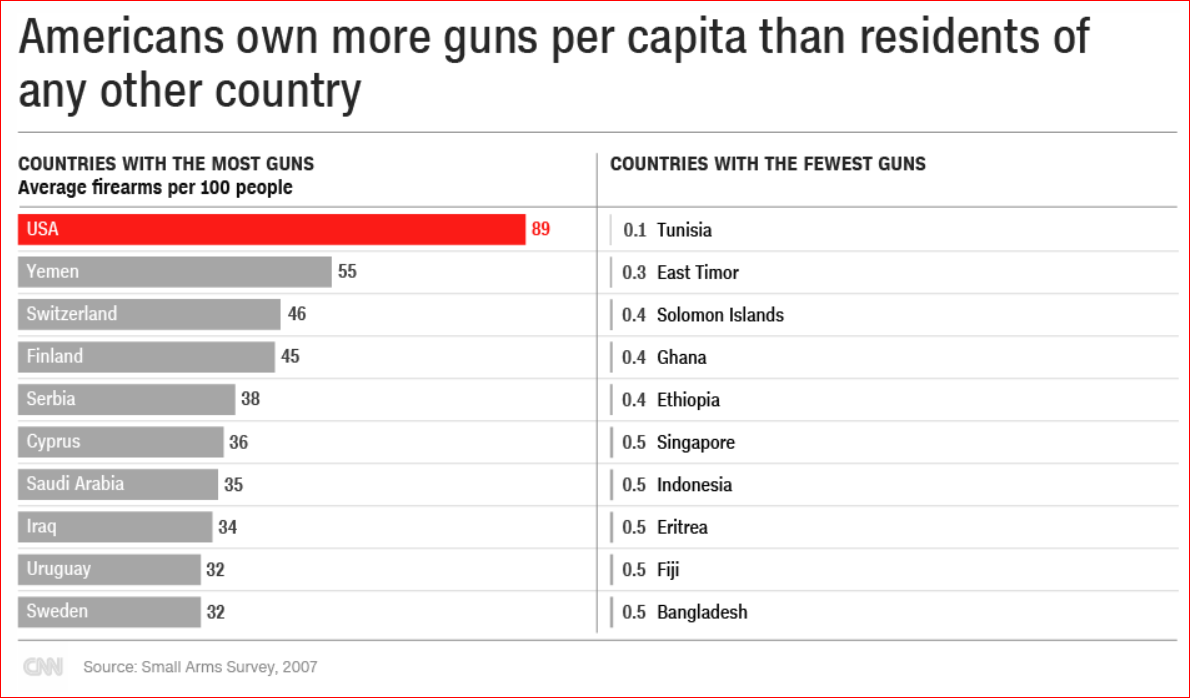
Americans own the most guns per person in the world, about four in 10 saying they either own a gun or live in a home with guns, according to a 2017 Pew Center study. Forty-eight percent of Americans said they grew up in a house with guns.
According to the survey, a majority (66%) of US gun owners own multiple firearms, with nearly three-quarters of gun owners saying they couldn't imagine not owning one.
Yemen, home to the world's second-largest gun-owning population per capita (and a country in the throes of a three-year-old civil conflict) trails significantly behind the US in terms of ownership.
When it comes to gun massacres, the US is an anomaly.
There are more public mass shootings in America than in any other country in the world.
On Wednesday, Nikolas Cruz, 19, arrived at the halls of his former school in Parkland, Florida. Armed with a rifle, he allegedly carried out a massacre that left 17 people dead.
In October 2017, 64-year-old gunman Stephen Paddock fired into crowds gathered at the Harvest Music Festival in Las Vegas. Fifty-eight people were killed and more than 500 people were injured. It was the deadliest mass shooting in modern US history.
In 2016, an attack at the Pulse nightclub in Orlando left 49 people dead. In 2012, Adam Lanza went on a shooting spree in Newtown, Connecticut, killing his mother before murdering 26 students and staff at Sandy Hook Elementary School; in 2007, 32 people were killed in the Virginia Tech massacre.
Such massacres have prompted debates about gun control, but they also increase demand for guns. And regulations covering the sale of firearms are looser now that they were a year ago.
In February 2017, US President Donald Trump signed a measure that scrapped an Obama-era regulation aimed at keeping guns out of the hands of some severely mentally ill people.
The original rule was part of a series of moves taken by the Obama administration to try and curb gun violence after other efforts failed to advance in Congress.
Globally, restrictive gun laws have proven to make a difference in curbing massacres.
In Australia, for example, four mass shootings occurred between 1987 and 1996. After those incidents, public opinion turned against gun ownership and Parliament passed stricter gun laws. Australia hasn't had a mass shooting since.
The US has one of the highest rates of death by firearm in the developed world, according to World Health Organization data.
Our calculations based on OECD data from 2010 show that Americans are 51 times more likely to be killed by gunfire than people in the United Kingdom.
Most American gun owners (two-thirds) say a major reason they own a gun is for their personal protection, according to the Pew study. However, the majority of America's firearm-related deaths are attributed to self-harm.
Gun-related suicides are eight times higher in the US than in other high-income nations.

Globally, the US sees fewer gun-related murders than many of its southern neighbors.
According to the Small Arms Survey, El Salvador is currently home to the most gun-related murders in the world (excluding active war-zones) with guns killing more than 90 people for every 100,000 of population.
From 2010-2015, Honduras saw the highest averages of gun-related homicides, with guns killing 67 out of every 100,000 people there.
Venezuela and El Salvador are close behind over the same five-year period, with 52 and 49 gun-related deaths, respectively, for every 100,000 of population.
The US rate over that period is 4.5 gun-related homicides per 100,000 people. US law enforcement agencies are not required to report on gun killings by police. Often, such incidents are recorded as "justifiable homicides," and may or may not be included in official homicide statistics, according to the Small Arms Survey.

Tuesday

President Obama on the attacks in Dallas Texas (Video/Transcript)

With your understanding, I want to begin with a few words about the situation back in the United States, specifically the situation in Dallas, Texas.  
 
My team has been keeping me updated throughout the morning of the evening in Dallas.  I spoke this morning with Mayor Rawlings of Dallas to convey the deepest condolences of the American people.  I told him that the federal government will provide whatever assistance Dallas may need as it deals with this tremendous tragedy. 

We still don’t know all the facts.  What we do know is that there has been a vicious, calculated and despicable attack on law enforcement.  Police in Dallas were on duty, doing their jobs, keeping people safe during peaceful protests.  These law enforcement officers were targeted, and nearly a dozen officers were shot.  Five were killed.  Other officers and at least one civilian were wounded -- some are in serious condition, and we are praying for their recovery. 

As I told Mayor Rawlings, I believe that I speak for every single American when I say that we are horrified over these events, and that we stand united with the people and the police department in Dallas.  According to police, there are multiple suspects.  We will learn more, undoubtedly, about their twisted motivations.  But let's be clear:  There is no possible justification for these kinds of attacks or any violence against law enforcement. The FBI is already in touch with the Dallas police, and anyone involved in these senseless murders will be held fully accountable.  Justice will be done. 

I will have more to say about this as the facts become more clear.  For now, let me just say that even as yesterday I spoke about our need to be concerned, as all Americans, about racial disparities in our criminal justice system, I also said yesterday that our police have an extraordinarily difficult job and the vast majority of them do their job in outstanding fashion.  I also indicated the degree to which we need to be supportive of those officers who do their job each and every day, protecting us and protecting our communities. 

Today is a wrenching reminder of the sacrifices that they make for us.  We also know that when people are armed with powerful weapons, unfortunately it makes attacks like these more deadly and more tragic. And in the days ahead, we’re going to have to consider those realities as well. 

In the meantime, today our focus is on the victims and their families.  They are heartbroken.  The entire city of Dallas is grieving.  Police across America, which is a tight-knit family, feels this loss to their core.  And we're grieving with them.  I’d ask all Americans to say a prayer for these officers and their families.  Keep them in your thoughts.  And as a nation, let’s remember to express our profound gratitude to our men and women in blue -- not just today, but every day.

Sunday

Vice President Joe Biden Weekly Address July 9, 2016 (Video/Transcript)

Vice President Joe Biden
 Weekly Address
The White House
July 9, 2016 
Although I didn’t know the five police officers who were killed, or the seven who were wounded in Dallas this week – I knew them.

They were the folks I grew up with: The boy with the most courage and the most compassion; the man with a brave heart and a generous soul, whose words were always encouraging; the son who made his mother proud every time he turned and smiled at her; and the friend who you could always count on. Being a cop wasn’t just what they did. It was who they were—like every officer who joined for essentially the same reason. There was something about them that made them think they could help, that they should serve, that they had a duty.

So when an assassin’s bullet targeted the police force in Dallas, it touched the soul of the nation. Those killed and wounded were protecting the safety of those who were peacefully protesting against racial injustices in the criminal justice system. Those who were marching against the kind of shocking images we saw in St. Paul and Baton Rouge—and have seen too often elsewhere—of too many black lives lost.

I believe the Dallas Police Department is one of the finest in the nation—and this incredibly diverse city can bridge any divide. To paraphrase Dallas Mayor Mike Rawlings, let us use our words carefully. Let us act with unity, not division. As Dallas Police Chief David Brown—one of the leading chiefs in America—said, “There are no words to describe the atrocity that occurred to our city, all I know is that this must stop, this divisiveness between our police and our citizens.”

As Americans, we are wounded by all of these deaths.  It’s on all of us to stand up, to speak out about disparities in our criminal justice system—just as it’s on all of us to stand up for the police who protect us in our communities every day. In the days and weeks ahead, we’ll continue offering our thoughts and prayers to provide comfort to the broken-hearted families. But they will only be redeemed by the courage of our actions that honor their memories.

So while we’re being tested, we can’t be pulled apart. We are America, with bonds that hold us together. We endure, we persevere, we overcome, we stand together.

Friday

US gun control: What is the NRA and why is it so powerful?

Source:BBC
It is one of the most powerful players in one of the most hotly-debated issues in the US - gun control - but what exactly is the NRA? Here's a quick guide.

What is the NRA?

NRA stands for National Rifle Association. The group was founded in 1871 as a recreational group designed to "promote and encourage rifle shooting on a scientific basis".

The NRA's path into political lobbying began in 1934 when it began mailing members with information about upcoming firearms bills. The association supported two major gun control acts, the National Firearms Act of 1934 (NFA) and Gun Control Act of 1968 (GCA), but became more politically active following the passage of the GCA in the 1970s.

In 1975, it began attempting to influence policy directly via a newly formed lobbying arm, the Institute for Legislative Action. In 1977 it formed its own Political Action Committee (PAC), to channel funds to legislators.


The NRA is now among the most powerful special interest lobby groups in the US, with a substantial budget to influence members of Congress on gun policy. It is run by executive vice president Wayne LaPierre.

How big is its budget?

The NRA spends about $250m per year, far more than all the country's gun control advocacy groups put together. But the NRA has a much larger membership than any of those groups and disburses funds for things such as gun ranges and educational programmes.

In terms of lobbying, the NRA officially spends about $3m per year to influence gun policy - the recorded spend on lobbying in 2014 was $3.3m. That is only the recorded contributions to lawmakers however, and considerable sums are spent elsewhere via PACs and independent expenditures - funds which are difficult to track.

Analysts point out that the NRA also wields considerable indirect influence via its highly politically engaged membership, many of whom will vote one way or another based on this single issue. The NRA publicly grades members of Congress from A to F on their perceived friendliness to gun rights. Those ratings can have a serious effect on poll numbers and even cost pro-gun control candidates a seat.

How big is the NRA?

Estimates of the NRA's membership have varied widely for decades. The association claimed that membership surged to close to five million people in response to the mass shooting at Sandy Hook school, but some analysts put the figure at closer to three million. The organisation has been accused of artificially inflating the figure.

The NRA has boasted some high-profile members over the years, including former President George HW Bush. Mr Bush resigned from the group in 1995 after Mr La Pierre referred to federal agents in the wake of the Oklahoma City bombing as "jack-booted thugs".

Current members include former vice-presidential candidate Sarah Palin, and actors Tom Selleck and Whoopi Goldberg. The late actor Charlton Heston was president of the NRA between 1998 and 2003. Heston famously held a rifle over his head at an NRA convention following the Columbine High School massacre and told gun control advocates they would have to take it "from my cold, dead hands".

Why is it controversial?

The NRA has lobbied heavily against all forms of gun control and argued aggressively that more guns make the country safer. It relies on, and staunchly defends, a disputed interpretation of the Second Amendment to the US Constitution, which it argues gives US citizens the rights to bear arms.

The association faced criticism from both sides of the political spectrum in the wake of the Sandy Hook shooting, when Mr La Pierre said that the lack of an armed guard at the school was to blame for the tragedy.


It staunchly opposes most local, state and federal legislation that would restrict gun ownership. For example, the NRA recently has lobbied for guns confiscated by the police to be resold, arguing that destroying the weapons is, in effect, a waste of perfectly good guns.

Likewise, it strongly supports legislation that expand gun rights such as "open-carry" laws, which allow gun owners to carry their weapons, unconcealed, in most public places.


National Rifle Assn and its Lobbyists in 2016

Client Profile: Summary, 2016
Major Political Contributor


A special interest's lobbying activity may go up or down over time, depending on how much attention the federal government is giving their issues. Particularly active clients often retain multiple lobbying firms, each with a team of lobbyists, to press their case for them.

Total Lobbying Expenditures: $735,000
   Subtotal for Parent National Rifle Assn: $635,000
   Subtotal for Subsidiary NRA Institute for Legislative Action: $100,000 

National Rifle Assn Lobbying by Industry
IndustryTotal
Gun Rights$735,000


Itemized Lobbying Expenses for National Rifle Assn
Firms HiredTotal Reported by Filer Reported Contract Expenses (included in Total Reported by Filer)
National Rifle Assn$635,000-
Prime Policy Group-$20,000
MW Capitol Strategies-$20,000
     $40,000
Italicized records not included in Total Reported by Filer

Lobbying Expenses Reported by Subsidiary NRA Institute for Legislative Action
Firms HiredTotal Reported by Filer Reported Contract Expenses (included in Total Reported by Filer)
Crossroads Strategies
$60,000
FTI Government Affairs
$20,000
S-3 Group
$20,000


Lobbyists representing National Rifle Assn , 2016:

Total number of lobbyists: 26
Total number of revolvers: 10 (38.5%)

Revolving Door Profile Revolving Door profile   Revolving Door Profile Former Congressman
Lobbying Firm HiredAmount Subsidiary (Lobbied For)Lobbyist
Crossroads Strategies $60,000 NRA Institute for Legislative Action Green, JohnRevolving Door Profile
Hall, G StewartRevolving Door Profile
Lapinski, Mathew
Moorhead, HunterRevolving Door Profile
Tilton, SteveRevolving Door Profile
Weiss, Todd MRevolving Door Profile
Wise, Matt Revolving Door Profile
FTI Government Affairs $20,000 NRA Institute for Legislative Action Murray, JefferiesRevolving Door Profile
MW Capitol Strategies $20,000 National Rifle Assn Williams, Michael
National Rifle Assn $635,000 National Rifle Assn Adkins, Todd
Atkinson, Jimmy
Calabrese, Brian
Cassidy, Benjamin L
Cox, Christopher W
Holland, James
Lapierre, Wayne R Jr
Lawrence, Jason
Lehman, David
Ouimet, JasonRevolving Door Profile
Pensoneau, Brandi
Recce, Susan
Thompson, Jack
Zealand, Christopher
Prime Policy Group $20,000 National Rifle Assn Walling, VickieRevolving Door Profile
S-3 Group $20,000 NRA Institute for Legislative Action Delgado, Martin
Scofield, JohnRevolving Door Profile

Wednesday

Remarks by the President on Common-Sense Gun Safety Reform (video/Transcript)

THE PRESIDENT:  Thank you.  (Applause.)  Thank you.  Thank you, everybody.  Please have a seat.  Thank you.  (Applause.)  Thank you so much.

Mark, I want to thank you for your introduction.  I still remember the first time we met, the time we spent together, and the conversation we had about Daniel.  And that changed me that day.  And my hope, earnestly, has been that it would change the country.

Five years ago this week, a sitting member of Congress and 18 others were shot at, at a supermarket in Tucson, Arizona.  It wasn’t the first time I had to talk to the nation in response to a mass shooting, nor would it be the last.  Fort Hood.  Binghamton.  Aurora.  Oak Creek.  Newtown.  The Navy Yard.  Santa Barbara.  Charleston.  San Bernardino.  Too many.

AUDIENCE MEMBER:  Too many.

AUDIENCE MEMBER:  Too many.

AUDIENCE MEMBER:  Too many.

THE PRESIDENT:  Thanks to a great medical team and the love of her husband, Mark, my dear friend and colleague, Gabby Giffords, survived.  She’s here with us today, with her wonderful mom.  (Applause.)  Thanks to a great medical team, her wonderful husband, Mark -- who, by the way, the last time I met with Mark  -- this is just a small aside -- you may know Mark’s twin brother is in outer space.  (Laughter.)  He came to the office, and I said, how often are you talking to him?  And he says, well, I usually talk to him every day, but the call was coming in right before the meeting so I think I may have not answered his call -- (laughter) -- which made me feel kind of bad.  (Laughter.)    That’s a long-distance call.  (Laughter.)  So I told him if his brother, Scott, is calling today, that he should take it.  (Laughter.)  Turn the ringer on.  (Laughter.)

I was there with Gabby when she was still in the hospital, and we didn’t think necessarily at that point that she was going to survive.  And that visit right before a memorial -- about an hour later Gabby first opened her eyes.  And I remember talking to mom about that.  But I know the pain that she and her family have endured these past five years, and the rehabilitation and the work and the effort to recover from shattering injuries.

And then I think of all the Americans who aren’t as fortunate.  Every single year, more than 30,000 Americans have their lives cut short by guns -- 30,000.  Suicides.  Domestic violence.  Gang shootouts.  Accidents.  Hundreds of thousands of Americans have lost brothers and sisters, or buried their own children.  Many have had to learn to live with a disability, or learned to live without the love of their life.

A number of those people are here today.  They can tell you some stories.  In this room right here, there are a lot of stories.  There’s a lot of heartache.  There’s a lot of resilience, there’s a lot of strength, but there’s also a lot of pain.  And this is just a small sample.

The United States of America is not the only country on Earth with violent or dangerous people.  We are not inherently more prone to violence.  But we are the only advanced country on Earth that sees this kind of mass violence erupt with this kind of frequency.  It doesn't happen in other advanced countries.  It’s not even close.  And as I’ve said before, somehow we’ve become numb to it and we start thinking that this is normal.

And instead of thinking about how to solve the problem, this has become one of our most polarized, partisan debates -- despite the fact that there’s a general consensus in America about what needs to be done.  That’s part of the reason why, on Thursday, I’m going to hold a town hall meeting in Virginia on gun violence.  Because my goal here is to bring good people on both sides of this issue together for an open discussion.

I’m not on the ballot again.  I’m not looking to score some points.  I think we can disagree without impugning other people’s motives or without being disagreeable.  We don't need to be talking past one another.  But we do have to feel a sense of urgency about it.  In Dr. King’s words, we need to feel the “fierce urgency of now.”  Because people are dying.  And the constant excuses for inaction no longer do, no longer suffice.

That’s why we’re here today.  Not to debate the last mass shooting, but to do something to try to prevent the next one.  (Applause.)  To prove that the vast majority of Americans, even if our voices aren’t always the loudest or most extreme, care enough about a little boy like Daniel to come together and take common-sense steps to save lives and protect more of our children.

Now, I want to be absolutely clear at the start -- and I’ve said this over and over again, this also becomes routine, there is a ritual about this whole thing that I have to do -- I believe in the Second Amendment.  It’s there written on the paper.  It guarantees a right to bear arms.  No matter how many times people try to twist my words around -- I taught constitutional law, I know a little about this -- (applause) -- I get it.  But I also believe that we can find ways to reduce gun violence consistent with the Second Amendment.

I mean, think about it.  We all believe in the First Amendment, the guarantee of free speech, but we accept that you can’t yell “fire” in a theater.  We understand there are some constraints on our freedom in order to protect innocent people.  We cherish our right to privacy, but we accept that you have to go through metal detectors before being allowed to board a plane. It’s not because people like doing that, but we understand that that’s part of the price of living in a civilized society.

And what’s often ignored in this debate is that a majority of gun owners actually agree.  A majority of gun owners agree that we can respect the Second Amendment while keeping an irresponsible, law-breaking feud from inflicting harm on a massive scale.

Today, background checks are required at gun stores.  If a father wants to teach his daughter how to hunt, he can walk into a gun store, get a background check, purchase his weapon safely and responsibly.  This is not seen as an infringement on the Second Amendment.  Contrary to the claims of what some gun rights proponents have suggested, this hasn’t been the first step in some slippery slope to mass confiscation.  Contrary to claims of some presidential candidates, apparently, before this meeting, this is not a plot to take away everybody’s guns.  You pass a background check; you purchase a firearm.

The problem is some gun sellers have been operating under a different set of rules.  A violent felon can buy the exact same weapon over the Internet with no background check, no questions asked.  A recent study found that about one in 30 people looking to buy guns on one website had criminal records -- one out of 30 had a criminal record.  We’re talking about individuals convicted of serious crimes -- aggravated assault, domestic violence, robbery, illegal gun possession.  People with lengthy criminal histories buying deadly weapons all too easily.  And this was just one website within the span of a few months.

So we’ve created a system in which dangerous people are allowed to play by a different set of rules than a responsible gun owner who buys his or her gun the right way and subjects themselves to a background check.  That doesn’t make sense.  Everybody should have to abide by the same rules.  Most Americans and gun owners agree.  And that’s what we tried to change three years ago, after 26 Americans -– including 20 children -– were murdered at Sandy Hook Elementary.

Two United States Senators -– Joe Manchin, a Democrat from West Virginia, and Pat Toomey, a Republican from Pennsylvania, both gun owners, both strong defenders of our Second Amendment rights, both with “A” grades from the NRA –- that’s hard to get  -- worked together in good faith, consulting with folks like our Vice President, who has been a champion on this for a long time, to write a common-sense compromise bill that would have required virtually everyone who buys a gun to get a background check.  That was it.  Pretty common-sense stuff.  Ninety percent of Americans supported that idea.  Ninety percent of Democrats in the Senate voted for that idea.  But it failed because 90 percent of Republicans in the Senate voted against that idea.

How did this become such a partisan issue?  Republican President George W. Bush once said, “I believe in background checks at gun shows or anywhere to make sure that guns don’t get into the hands of people that shouldn’t have them.”  Senator John McCain introduced a bipartisan measure to address the gun show loophole, saying, “We need this amendment because criminals and terrorists have exploited and are exploiting this very obvious loophole in our gun safety laws.”  Even the NRA used to support expanded background checks.  And by the way, most of its members still do.  Most Republican voters still do.

How did we get here?  How did we get to the place where people think requiring a comprehensive background check means taking away people’s guns?

Each time this comes up, we are fed the excuse that common-sense reforms like background checks might not have stopped the last massacre, or the one before that, or the one before that, so why bother trying.  I reject that thinking.  (Applause.)  We know we can’t stop every act of violence, every act of evil in the world.  But maybe we could try to stop one act of evil, one act of violence.

Some of you may recall, at the same time that Sandy Hook happened, a disturbed person in China took a knife and tried to kill -- with a knife -- a bunch of children in China.  But most of them survived because he didn’t have access to a powerful weapon.  We maybe can’t save everybody, but we could save some.  Just as we don’t prevent all traffic accidents but we take steps to try to reduce traffic accidents.

As Ronald Reagan once said, if mandatory background checks could save more lives, “it would be well worth making it the law of the land.”  The bill before Congress three years ago met that test.  Unfortunately, too many senators failed theirs.  (Applause.)

In fact, we know that background checks make a difference.  After Connecticut passed a law requiring background checks and gun safety courses, gun deaths decreased by 40 percent -- 40 percent.  (Applause.)  Meanwhile, since Missouri repealed a law requiring comprehensive background checks and purchase permits, gun deaths have increased to almost 50 percent higher than the national average.  One study found, unsurprisingly, that criminals in Missouri now have easier access to guns.

And the evidence tells us that in states that require background checks, law-abiding Americans don’t find it any harder to purchase guns whatsoever.  Their guns have not been confiscated.  Their rights have not been infringed.

And that’s just the information we have access to.  With more research, we could further improve gun safety.  Just as with more research, we’ve reduced traffic fatalities enormously over the last 30 years.  We do research when cars, food, medicine, even toys harm people so that we make them safer.  And you know what -- research, science -- those are good things.  They work.  (Laughter and applause.)  They do.

But think about this.  When it comes to an inherently deadly weapon -- nobody argues that guns are potentially deadly -- weapons that kill tens of thousands of Americans every year, Congress actually voted to make it harder for public health experts to conduct research into gun violence; made it harder to collect data and facts and develop strategies to reduce gun violence.  Even after San Bernardino, they’ve refused to make it harder for terror suspects who can’t get on a plane to buy semi-automatic weapons.  That’s not right.  That can't be right.

So the gun lobby may be holding Congress hostage right now, but they cannot hold America hostage.  (Applause.)  We do not have to accept this carnage as the price of freedom.  (Applause.)

Now, I want to be clear.  Congress still needs to act.  The folks in this room will not rest until Congress does.  (Applause.)  Because once Congress gets on board with common-sense gun safety measures we can reduce gun violence a whole lot more.  But we also can't wait.  Until we have a Congress that’s in line with the majority of Americans, there are actions within my legal authority that we can take to help reduce gun violence and save more lives -– actions that protect our rights and our kids.

After Sandy Hook, Joe and I worked together with our teams and we put forward a whole series of executive actions to try to tighten up the existing rules and systems that we had in place.  But today, we want to take it a step further.  So let me outline what we're going to be doing.

Number one, anybody in the business of selling firearms must get a license and conduct background checks, or be subject to criminal prosecutions.  (Applause.)  It doesn’t matter whether you’re doing it over the Internet or at a gun show.  It’s not where you do it, but what you do.

We’re also expanding background checks to cover violent criminals who try to buy some of the most dangerous firearms by hiding behind trusts and corporations and various cutouts.

We're also taking steps to make the background check system more efficient.  Under the guidance of Jim Comey and the FBI, our Deputy Director Tom Brandon at ATF, we’re going to hire more folks to process applications faster, and we’re going to bring an outdated background check system into the 21st century.  (Applause.)

And these steps will actually lead to a smoother process for law-abiding gun owners, a smoother process for responsible gun dealers, a stronger process for protecting the people from -- the public from dangerous people.  So that's number one.

Number two, we’re going to do everything we can to ensure the smart and effective enforcement of gun safety laws that are already on the books, which means we're going to add 200 more ATF agents and investigators.  We're going to require firearms dealers to report more lost or stolen guns on a timely basis. We're working with advocates to protect victims of domestic abuse from gun violence, where too often -- (applause) -- where too often, people are not getting the protection that they need.
Number three, we're going to do more to help those suffering from mental illness get the help that they need.  (Applause.)  High-profile mass shootings tend to shine a light on those few mentally unstable people who inflict harm on others.  But the truth is, is that nearly two in three gun deaths are from suicides.  So a lot of our work is to prevent people from hurting themselves.

That’s why we made sure that the Affordable Care Act -- also known as Obamacare -- (laughter and applause) -- that law made sure that treatment for mental health was covered the same as treatment for any other illness.  And that’s why we’re going to invest $500 million to expand access to treatment across the country.  (Applause.)

It’s also why we’re going to ensure that federal mental health records are submitted to the background check system, and remove barriers that prevent states from reporting relevant information.  If we can continue to de-stigmatize mental health issues, get folks proper care, and fill gaps in the background check system, then we can spare more families the pain of losing a loved one to suicide.

And for those in Congress who so often rush to blame mental illness for mass shootings as a way of avoiding action on guns, here’s your chance to support these efforts.  Put your money where your mouth is.  (Applause.)

Number four, we’re going to boost gun safety technology.  Today, many gun injuries and deaths are the result of legal guns that were stolen or misused or discharged accidentally.  In 2013 alone, more than 500 people lost their lives to gun accidents –- and that includes 30 children younger than five years old.  In the greatest, most technologically advanced nation on Earth, there is no reason for this.  We need to develop new technologies that make guns safer.  If we can set it up so you can’t unlock your phone unless you’ve got the right fingerprint, why can’t we do the same thing for our guns?  (Applause.)  If there’s an app that can help us find a missing tablet -- which happens to me often the older I get -- (laughter) -- if we can do it for your iPad, there’s no reason we can’t do it with a stolen gun.  If a child can’t open a bottle of aspirin, we should make sure that they can’t pull a trigger on a gun.  (Applause.)  Right?

So we’re going to advance research.  We’re going to work with the private sector to update firearms technology.

And some gun retailers are already stepping up by refusing to finalize a purchase without a complete background check, or by refraining from selling semi-automatic weapons or high-capacity magazines.  And I hope that more retailers and more manufacturers join them -- because they should care as much as anybody about a product that now kills almost as many Americans as car accidents.
I make this point because none of us can do this alone.  I think Mark made that point earlier.  All of us should be able to work together to find a balance that declares the rest of our rights are also important -- Second Amendment rights are important, but there are other rights that we care about as well. And we have to be able to balance them.  Because our right to worship freely and safely –- that right was denied to Christians in Charleston, South Carolina.  (Applause.)  And that was denied Jews in Kansas City.  And that was denied Muslims in Chapel Hill, and Sikhs in Oak Creek.  (Applause.)

They had rights, too.  (Applause.)

Our right to peaceful assembly -– that right was robbed from moviegoers in Aurora and Lafayette.  Our unalienable right to life, and liberty, and the pursuit of happiness -– those rights were stripped from college students in Blacksburg and Santa Barbara, and from high schoolers at Columbine, and from first-graders in Newtown.  First-graders.  And from every family who never imagined that their loved one would be taken from our lives by a bullet from a gun.

Every time I think about those kids it gets me mad.  And by the way, it happens on the streets of Chicago every day.  (Applause.)

So all of us need to demand a Congress brave enough to stand up to the gun lobby’s lies.  All of us need to stand up and protect its citizens.  All of us need to demand governors and legislatures and businesses do their part to make our communities safer.  We need the wide majority of responsible gun owners who grieve with us every time this happens and feel like your views are not being properly represented to join with us to demand something better.  (Applause.)

And we need voters who want safer gun laws, and who are disappointed in leaders who stand in their way, to remember come election time.  (Applause.)

I mean, some of this is just simple math.  Yes, the gun lobby is loud and it is organized in defense of making it effortless for guns to be available for anybody, any time.  Well, you know what, the rest of us, we all have to be just as passionate.  We have to be just as organized in defense of our kids.  This is not that complicated.  The reason Congress blocks laws is because they want to win elections.  And if you make it hard for them to win an election if they block those laws, they’ll change course, I promise you.  (Applause.)

And, yes, it will be hard, and it won’t happen overnight.  It won’t happen during this Congress.  It won’t happen during my presidency.  But a lot of things don’t happen overnight.  A woman’s right to vote didn’t happen overnight.  The liberation of African Americans didn’t happen overnight.  LGBT rights -- that was decades’ worth of work.  So just because it’s hard, that’s no excuse not to try.

And if you have any doubt as to why you should feel that “fierce urgency of now,” think about what happened three weeks ago.  Zaevion Dobson was a sophomore at Fulton High School in Knoxville, Tennessee.  He played football; beloved by his classmates and his teachers.  His own mayor called him one of their city’s success stories.  The week before Christmas, he headed to a friend’s house to play video games.  He wasn’t in the wrong place at the wrong time.  He hadn’t made a bad decision.  He was exactly where any other kid would be.  Your kid.  My kids. And then gunmen started firing.  And Zaevion -- who was in high school, hadn’t even gotten started in life -- dove on top of three girls to shield them from the bullets.  And he was shot in the head.  And the girls were spared.  He gave his life to save theirs –- an act of heroism a lot bigger than anything we should ever expect from a 15-year-old.  “Greater love hath no man than this that a man lay down his life for his friends.”

We are not asked to do what Zaevion Dobson did.  We’re not asked to have shoulders that big; a heart that strong; reactions that quick.  I’m not asking people to have that same level of courage, or sacrifice, or love.  But if we love our kids and care about their prospects, and if we love this country and care about its future, then we can find the courage to vote.  We can find the courage to get mobilized and organized.  We can find the courage to cut through all the noise and do what a sensible country would do.

That’s what we’re doing today.  And tomorrow, we should do more.  And we should do more the day after that.  And if we do, we’ll leave behind a nation that’s stronger than the one we inherited and worthy of the sacrifice of a young man like Zaevion.  (Applause.)

Thank you very much, everybody.  God bless you.  Thank you.  God bless America.  (Applause.)

Saturday

President Barack Obama Weekly Address January 1, 2016 (Video/Transcript)

President Barack Obama
Weekly Address
The White House
January 1, 2016
Happy New Year, everybody. I am fired up for the year that stretches out before us. That’s because of what we’ve accomplished together over the past seven.

Seven years ago, our businesses were losing 800,000 jobs a month. They’ve now created jobs for 69 straight months, driving the unemployment rate from a high of 10% down to 5%.

Seven years ago, too many Americans went without health insurance. We’ve now covered more than 17 million people, dropping the rate of the uninsured below 10% for the very first time.

Seven years ago, we were addicted to foreign oil. Now our oil imports have plummeted, our clean energy industry is booming, and America is a global leader in the fight against climate change.
Seven years ago, there were only two states in America with marriage equality. And now there are 50.

All of this progress is because of you. And we’ve got so much more to do. So my New Year’s resolution is to move forward on our unfinished business as much as I can. And I’ll be more frequently asking for your help. That’s what this American project is all about.

That's especially true for one piece of unfinished business, that’s our epidemic of gun violence.
Last month, we remembered the third anniversary of Newtown. This Friday, I’ll be thinking about my friend Gabby Giffords, five years into her recovery from the shooting in Tucson. And all across America, survivors of gun violence and those who lost a child, a parent, a spouse to gun violence are forced to mark such awful anniversaries every single day.

And yet Congress still hasn’t done anything to prevent what happened to them from happening to other families. Three years ago, a bipartisan, commonsense bill would have required background checks for virtually everyone who buys a gun. Keep in mind, this policy was supported by some 90% of the American people. It was supported by a majority of NRA households. But the gun lobby mobilized against it. And the Senate blocked it.

Since then, tens of thousands of our fellow Americans have been mowed down by gun violence. Tens of thousands. Each time, we’re told that commonsense reforms like background checks might not have stopped the last massacre, or the one before that, so we shouldn’t do anything.

We know that we can’t stop every act of violence. But what if we tried to stop even one? What if Congress did something – anything – to protect our kids from gun violence?

A few months ago, I directed my team at the White House to look into any new actions I can take to help reduce gun violence. And on Monday, I’ll meet with our Attorney General, Loretta Lynch, to discuss our options. Because I get too many letters from parents, and teachers, and kids, to sit around and do nothing. I get letters from responsible gun owners who grieve with us every time these tragedies happen; who share my belief that the Second Amendment guarantees a right to bear arms; and who share my belief we can protect that right while keeping an irresponsible, dangerous few from inflicting harm on a massive scale.

Tuesday

President Obama Addresses the Nation on Keeping the American People Safe (Video/Trabscript)


Good evening. On Wednesday, 14 Americans were killed as they came together to celebrate the holidays. They were taken from family and friends who loved them deeply. They were white and black; Latino and Asian; immigrants and American-born; moms and dads; daughters and sons. Each of them served their fellow citizens and all of them were part of our American family.

Tonight, I want to talk with you about this tragedy, the broader threat of terrorism, and how we can keep our country safe.

The FBI is still gathering the facts about what happened in San Bernardino, but here is what we know. The victims were brutally murdered and injured by one of their coworkers and his wife. So far, we have no evidence that the killers were directed by a terrorist organization overseas, or that they were part of a broader conspiracy here at home. But it is clear that the two of them had gone down the dark path of radicalization, embracing a perverted interpretation of Islam that calls for war against America and the West. They had stockpiled assault weapons, ammunition, and pipe bombs. So this was an act of terrorism, designed to kill innocent people.

Our nation has been at war with terrorists since al Qaeda killed nearly 3,000 Americans on 9/11. In the process, we’ve hardened our defenses — from airports to financial centers, to other critical infrastructure. Intelligence and law enforcement agencies have disrupted countless plots here and overseas, and worked around the clock to keep us safe. Our military and counterterrorism professionals have relentlessly pursued terrorist networks overseas — disrupting safe havens in several different countries, killing Osama bin Laden, and decimating al Qaeda’s leadership.

Over the last few years, however, the terrorist threat has evolved into a new phase. As we’ve become better at preventing complex, multifaceted attacks like 9/11, terrorists turned to less complicated acts of violence like the mass shootings that are all too common in our society. It is this type of attack that we saw at Fort Hood in 2009; in Chattanooga earlier this year; and now in San Bernardino. And as groups like ISIL grew stronger amidst the chaos of war in Iraq and then Syria, and as the Internet erases the distance between countries, we see growing efforts by terrorists to poison the minds of people like the Boston Marathon bombers and the San Bernardino killers.

For seven years, I’ve confronted this evolving threat each morning in my intelligence briefing. And since the day I took this office, I’ve authorized U.S. forces to take out terrorists abroad precisely because I know how real the danger is. As Commander-in-Chief, I have no greater responsibility than the security of the American people. As a father to two young daughters who are the most precious part of my life, I know that we see ourselves with friends and coworkers at a holiday party like the one in San Bernardino. I know we see our kids in the faces of the young people killed in Paris. And I know that after so much war, many Americans are asking whether we are confronted by a cancer that has no immediate cure.

Well, here’s what I want you to know: The threat from terrorism is real, but we will overcome it. We will destroy ISIL and any other organization that tries to harm us. Our success won’t depend on tough talk, or abandoning our values, or giving into fear. That’s what groups like ISIL are hoping for. Instead, we will prevail by being strong and smart, resilient and relentless, and by drawing upon every aspect of American power.

Here’s how. First, our military will continue to hunt down terrorist plotters in any country where it is necessary. In Iraq and Syria, airstrikes are taking out ISIL leaders, heavy weapons, oil tankers, infrastructure. And since the attacks in Paris, our closest allies — including France, Germany, and the United Kingdom — have ramped up their contributions to our military campaign, which will help us accelerate our effort to destroy ISIL.

Second, we will continue to provide training and equipment to tens of thousands of Iraqi and Syrian forces fighting ISIL on the ground so that we take away their safe havens. In both countries, we’re deploying Special Operations Forces who can accelerate that offensive. We’ve stepped up this effort since the attacks in Paris, and we’ll continue to invest more in approaches that are working on the ground.

Third, we’re working with friends and allies to stop ISIL’s operations — to disrupt plots, cut off their financing, and prevent them from recruiting more fighters. Since the attacks in Paris, we’ve surged intelligence-sharing with our European allies. We’re working with Turkey to seal its border with Syria. And we are cooperating with Muslim-majority countries — and with our Muslim communities here at home — to counter the vicious ideology that ISIL promotes online.

Fourth, with American leadership, the international community has begun to establish a process — and timeline — to pursue ceasefires and a political resolution to the Syrian war. Doing so will allow the Syrian people and every country, including our allies, but also countries like Russia, to focus on the common goal of destroying ISIL — a group that threatens us all.

This is our strategy to destroy ISIL. It is designed and supported by our military commanders and counterterrorism experts, together with 65 countries that have joined an American-led coalition. And we constantly examine our strategy to determine when additional steps are needed to get the job done. That’s why I’ve ordered the Departments of State and Homeland Security to review the visa program under which the female terrorist in San Bernardino originally came to this country. And that’s why I will urge high-tech and law enforcement leaders to make it harder for terrorists to use technology to escape from justice.

Now, here at home, we have to work together to address the challenge. There are several steps that Congress should take right away.

To begin with, Congress should act to make sure no one on a no-fly list is able to buy a gun. What could possibly be the argument for allowing a terrorist suspect to buy a semi-automatic weapon? This is a matter of national security.

We also need to make it harder for people to buy powerful assault weapons like the ones that were used in San Bernardino. I know there are some who reject any gun safety measures. But the fact is that our intelligence and law enforcement agencies — no matter how effective they are — cannot identify every would-be mass shooter, whether that individual is motivated by ISIL or some other hateful ideology. What we can do — and must do — is make it harder for them to kill.

Next, we should put in place stronger screening for those who come to America without a visa so that we can take a hard look at whether they’ve traveled to warzones. And we’re working with members of both parties in Congress to do exactly that.

Finally, if Congress believes, as I do, that we are at war with ISIL, it should go ahead and vote to authorize the continued use of military force against these terrorists. For over a year, I have ordered our military to take thousands of airstrikes against ISIL targets. I think it’s time for Congress to vote to demonstrate that the American people are united, and committed, to this fight.

My fellow Americans, these are the steps that we can take together to defeat the terrorist threat. Let me now say a word about what we should not do.

We should not be drawn once more into a long and costly ground war in Iraq or Syria. That’s what groups like ISIL want. They know they can’t defeat us on the battlefield. ISIL fighters were part of the insurgency that we faced in Iraq. But they also know that if we occupy foreign lands, they can maintain insurgencies for years, killing thousands of our troops, draining our resources, and using our presence to draw new recruits.

The strategy that we are using now — airstrikes, Special Forces, and working with local forces who are fighting to regain control of their own country — that is how we’ll achieve a more sustainable victory. And it won’t require us sending a new generation of Americans overseas to fight and die for another decade on foreign soil.

Here’s what else we cannot do. We cannot turn against one another by letting this fight be defined as a war between America and Islam. That, too, is what groups like ISIL want. ISIL does not speak for Islam. They are thugs and killers, part of a cult of death, and they account for a tiny fraction of more than a billion Muslims around the world — including millions of patriotic Muslim Americans who reject their hateful ideology. Moreover, the vast majority of terrorist victims around the world are Muslim. If we’re to succeed in defeating terrorism we must enlist Muslim communities as some of our strongest allies, rather than push them away through suspicion and hate.

That does not mean denying the fact that an extremist ideology has spread within some Muslim communities. This is a real problem that Muslims must confront, without excuse. Muslim leaders here and around the globe have to continue working with us to decisively and unequivocally reject the hateful ideology that groups like ISIL and al Qaeda promote; to speak out against not just acts of violence, but also those interpretations of Islam that are incompatible with the values of religious tolerance, mutual respect, and human dignity.

But just as it is the responsibility of Muslims around the world to root out misguided ideas that lead to radicalization, it is the responsibility of all Americans — of every faith — to reject discrimination. It is our responsibility to reject religious tests on who we admit into this country. It’s our responsibility to reject proposals that Muslim Americans should somehow be treated differently. Because when we travel down that road, we lose. That kind of divisiveness, that betrayal of our values plays into the hands of groups like ISIL. Muslim Americans are our friends and our neighbors, our co-workers, our sports heroes — and, yes, they are our men and women in uniform who are willing to die in defense of our country. We have to remember that.

My fellow Americans, I am confident we will succeed in this mission because we are on the right side of history. We were founded upon a belief in human dignity — that no matter who you are, or where you come from, or what you look like, or what religion you practice, you are equal in the eyes of God and equal in the eyes of the law.

Even in this political season, even as we properly debate what steps I and future Presidents must take to keep our country safe, let’s make sure we never forget what makes us exceptional.
Let’s not forget that freedom is more powerful than fear;
that we have always met challenges — whether war or depression, natural disasters or terrorist attacks — by coming together around our common ideals as one nation, as one people. So long as we stay true to that tradition, I have no doubt America will prevail.

Thank you. God bless you, and may God bless the United States of America.


Monday

How the Gun-Rights Lobby Won After Newtown

Watch Frontline Gunned-Down and read How the Gun-Rights Lobby Won After Newtown. How American politics is controlled by National Rifle Association (NRA)!

by
 
Even by the standards of mass public shootings in America, what happened last year at Sandy Hook Elementary School was staggering. Twenty-six victims, most no older than seven, were gunned down in their classrooms days before Christmas.

For gun-control advocates, Newtown offered an unprecedented moment to push to reform the nation’s gun laws. The day of the shooting, a visibly moved President Barack Obama called for “meaningful action.” One month later, a coalition of grieving Sandy Hook parents vowed to fight nationwide for “sensible solutions to prevent gun violence.” Some politicians with top ratings from the National Rifle Association (NRA) even indicated they’d be willing to consider new laws.

It didn’t quite work out that way.

In the wake of Sandy Hook, the gun-rights lobby outspent, out-organized and out-maneuvered gun-control advocates at both the state and federal level. A FRONTLINE examination of state legislation and federal lobbying expenditures shows that gun-rights groups outspent gun-control backers by nearly $10 million, and that around the country, states passed more than twice as many laws expanding gun owners’ rights than they did gun-control measures.

Representatives of the two top national gun lobbying organizations declined to talk to FRONTLINE about their efforts this past year. But records show that since Sandy Hook, 27 states have passed 93 laws expanding gun rights, including measures allowing people to carry concealed weapons in churches, public parks and schools, and to accept gun permits from neighboring states. In Congress, gun-rights lobbyists helped defeat the most comprehensive reform bill proposed in nearly two decades.

What happened?

“As upset as people who don’t own guns are about the misuse of guns — and of course gun owners are too — at the end of the day, they aren’t going to vote for or against you on the basis of what you do on this issue,” said Richard Feldman, president of the Independent Firearms Owners Association, who advocates what he calls “effective solutions” on guns. “Gun owners are going to vote, and they care deeply about this issue.”

Gun-control advocates say that they’re just beginning to gain momentum to challenge the well-funded and organized gun-rights movement. But they’ve also run up against the current political reality of guns in the U.S.

“These Are Good Bills”

Within three months of the shooting, states were consider more than 1,000 pieces of legislation — about half to expand gun rights, and the other half to curtail them.

By the end of 2013, only 43 gun-control laws had passed, nearly one-quarter of them in California.

Colorado legislators passed four laws, including expanded background checks and a ban on most magazines with more than 15 rounds. But the outcry among gun-rights supporters was so great that two senators who voted for the measures were recalled in September, and another stepped down last month to avoid being ousted. Gov. John Hickenlooper, who is running for re-election next year, is also struggling to stay ahead in the polls.

In Rhode Island, gun-rights advocates successfully lobbied to modify proposed gun-control bills until they felt they didn’t impose on firearm owners’ rights. The Providence Journal documented the House vote:
“They’ve been kind to us gun folks,” said Rep. Doreen Marie Costa on the House floor. “I want to make sure the NRA people and the [Federated Rhode Island Sportsmen’s Club] can hear this,” Costa added, as the lobbyists and gun-rights advocates watched from the balcony. “These are good bills.”
 MAP: Which states have passed gun bills since Newtown?

A New Gun-Rights Power

In January, President Obama announced 23 executive actions intended to strengthen the enforcement of existing gun laws. Last month, he touted some progress, including improving the national background-check database and appointing a director of the Bureau of Alcohol, Tobacco and Firearms, a post that’s been vacant for seven years.

But the administration’s major effort to pass what would have been the most sweeping reform in nearly two decades — new legislation that would have expanded background checks to include gun shows and online sales — failed within months in the Democrat-controlled Senate.

The legislation was staunchly opposed by gun-rights groups, including a powerful newcomer in the federal arena.

The National Association for Gun Rights, or NAGR, which considers itself to the right of the powerful NRA, spent nearly $6 million in lobbying this year through September 2013 — more than double what the NRA paid out and far more than any other group on either side of the debate.
The NAGR was founded in 2001, but until this
 year it focused mainly on advocacy, keeping local groups apprised of gun legislation in their states. The source of its funding isn’t clear because as a 501(c)4, the NAGR isn’t required to disclose its backers.

The group’s leadership has ties to former Rep. Ron Paul (R-Texas) and his son, Sen. Rand Paul (R-Ky.), according to the Center for Responsive Politics.
The group’s executive vice president, Dudley Brown, declined to talk to FRONTLINE for this story. But earlier this year, Brown told the Center for Responsive Politics that the Sandy Hook shooting prompted the group to get involved on the federal level.

“We had not hired a federal lobbyist previous to that point, and we immediately started seeking one out after Connecticut,” he said. The group gained notoriety for running attack ads again Republican members of Congress, including Eric Cantor, the House majority whip, accusing them of supporting the president’s gun-control initiatives.
CHART:Who’s spending the most on firearms lobbying?

The “Connecticut Effect”

Gun-control advocates have never been as organized, as wealthy or as motivated as gun-rights groups, so even with the newfound momentum that some have called the “Connecticut effect,” they’re working at a disadvantage.

But in 2013, gun-control advocates marked several victories, including in Connecticut, one of the few states to pass comprehensive gun control legislation. After the shooting, gun-control groups in the state gained thousands of new members. Suburban moms speed-dialed legislators every Friday at 9:30 a.m., the moment the shooting at Sandy Hook Elementary began. Other groups formed to march against gun violence, and advocates showed up at legislative hearings to counter pro-gun supporters.

That kind of grassroots power is new for the gun-control movement — and something they admit will take years to replicate nationwide. The goal: create enough baseline support for legislators so they can vote for gun-control measures without fearing for their political lives.

“A year ago, not only were we swimming against the tide, there wasn’t much hope at all that people felt in terms of passing laws that would actually save lives,” said Dan Gross, president of the Brady Campaign to Prevent Gun Violence.

Now, he said, “We’re on the right trajectory. Every day that we wake up, we’re focused on continuing that momentum that we’ve established, with grassroots organizing across the country, new levels of membership, and funding that this issue hasn’t seen in years. It all is headed in the right direction.”

The question now is what happens next year, as the 2014 midterm elections approach. Mayors Against Illegal Guns, the largest gun-control group in terms of lobbying expenditures, plans to continue to back politicians who side with them and attack those who don’t. The Brady Campaign says it’s working with federal lawmakers to craft a new background-check bill, although they declined to name names on a recent conference call with reporters.

“It will take us awhile to match what the NRA has accomplished in two decades, but I think it’s happening a lot faster than anyone thought it would,” said Mark Glaze, Mayors’ director.

But the gun-rights movement isn’t likely to lose its momentum, either. The NAGR rallied its supporters this week to oppose Congress’ extension of a ban on plastic guns that can avoid detection by airport security. Although the bill passed, it lacked new restrictions proposed by gun-control supporters.

And, the NRA, which plans to reintroduce gun-rights legislation that failed at the state level, has billed 2014 as the “biggest battle for gun rights in our lifetime.”